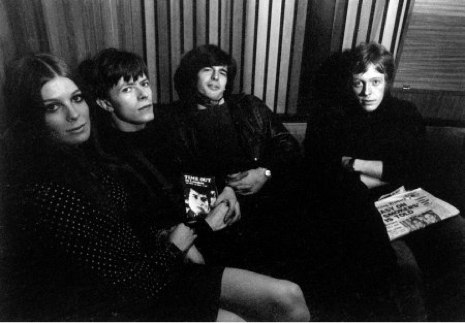
In 1969, for the first time in his career, David Bowie was unsure of himself. In his own words, "I was looking for myself". Producer Tony Visconti, who would become a long-standing Bowie collaborator, had only produced two previous albums and was unsure what to do either. The band, 'Junior's Eyes', didn't know what was expected of them. The band never played the songs live. The result is a missed opportunity.
Confusingly released in Britain as 'David Bowie' (the second album with this name - in the US it was given the appalling title of 'Man of Words/Man of Music' and in 1972 it was re-issued at the height of Bowie's fame as 'Space Oddity', which is how I have known it for the last twenty years), Bowie's second full-length offering lacked an overall vision. Some of the songs sound as though they could have been recorded at any point since about 1967, a hippy feel with a bit of Bob Dylan in there. There is a tiny bit of Bowie's former show-tune style. But Bowie's song-writing was finally reaching maturity and there are one or two songs that point the way to new horizons.
A great song is 'God Knows I'm Good' about an old woman 'hot with worry', her face 'white with fear' who feels compelled to steal a tin of stewing steak, presumably because she can't afford it, forcing us to ask who the real criminal is. 'Memory Of A Free Festival' tells of a festival he organised with Beckenham Arts Lab. My favourite, however, is the much-maligned 'Cygnet Committee'. At 9 minutes, 33 seconds it was Bowie's longest song until 'Station to Station' at 10 minutes, 14 seconds. 'Cygnet Committee' contains a recurring theme of Bowie songs, that of the messiah. Bowie based this song on the way he had come to feel about hippies, as he saw it, leeching off him and using him and the Arts Lab for their own ends rather than that of the cause. He also felt that the hippy cause could be manipulated by a messianic figure for devious ends and that people would still blindly follow them.
Despite perhaps not showing Bowie at his best, there is some excellent song-writing here and if it were not for the fact that he made so many better albums later, it might even be seen as a great album.
'David Bowie' (1969, re-issued as 'Space Oddity' in 1972)
All songs written and composed by David Bowie
| Side one | ||||||||||
|---|---|---|---|---|---|---|---|---|---|---|
| No. | Title | Length | ||||||||
| 1. | 'Space Oddity' | 5:15 |
| 2. | 'Unwashed and Somewhat Slightly Dazed' | 6:55 |
| 3. | "(Don't Sit Down)" (On subsequent re-releases, the track was appended to "Unwashed and Somewhat Slightly Dazed", and on the Space Oddity reissue, this track was removed completely.) | 0:39 |
| 4. | 'Letter to Hermione' | 2:28 |
| 5. | 'Cygnet Committee' | 9:33 |
| Side two | ||||||||||
|---|---|---|---|---|---|---|---|---|---|---|
| No. | Title | Length | ||||||||
| 6. | 'Janine' | 3:18 | ||||||||
| 7. | 'An Occasional Dream' | 2:51 | ||||||||
| 8. | 'Wild Eyed Boy from Freecloud | 4:45 | ||||||||
| 9. | 'God Knows I'm Good' | 3:13 | ||||||||
| 10. | 'Memory of a Free Festival' | 7:05 | ||||||||
In 1969, Bowie met Angela Barnett and they married a year later. Bowie once said they met "because we were both going out with the same man". That man was Calvin Mark Lee, Head of Promotions at Mercury Records. Lee claims he had a sexual relationship with Bowie and Barnett was his girlfriend. They all went for a Chinese meal at Lee's expense at the rest, as they say, is history. Bowie and Barnett moved into a flat in Haddon Hall, a large Victorian house in Beckenham. Other residents included Tony Visconti, Bowie's producer, and his girlfriend, John Cambridge, Bowie's drummer and sometimes Bowie's half-brother Terry. Bowie wasn't writing much during this period but he wrote a song for his new love called 'The Prettiest Star'.
On 8 January 1970, his 23rd birthday, Bowie went into the recording studio to record the song as a follow-up single to 'Space Oddity'. Tony Visconti had arranged for Marc Bolan to play lead guitar on the track. Bowie and Bolan had enjoyed a friendly rivalry for a number of years and all was going well until Bolan's wife June said "The only good thing about this record is Marc's guitar". Marc hurriedly left the studio. The song would become well known three years later when Bowie re-recorded the song for his 'Aladdin Sane' album with Mick Ronson faithfully recreating Marc's solo note for note. The original, whilst being slightly slower, more laid-back and less tight, is actually remarkably similar to the more well-known version, yet it reportedly sold less than 800 copies.
 By 1970, Bowie's backing band 'Junior's Eyes' was falling apart. Guitarist Mick Wayne's drug intake was making him unreliable. Drummer John Cambridge suggested a guitarist he had played with in his preious band 'The Rats'. His name was Mick Ronson. From the moment Bowie heard Ronson play the two clicked. Bowie quickly taught Ronson his songs and they formed a new band: The Hype. Drummer Cambridge was a cowboy, guitarist Ronson was known as 'Gangsterman', Visconti on bass was known as 'Hypeman' and Bowie was 'Rainbowman'. After having abuse shouted at them at gigs, the band dropped the outfits and reverted to playing as 'David Bowie' but the music worked. The band's first job in the studio was to re-work 'Memory of a Free Festival' as a single but not before Cambridge, who was struggling with a difficult bass drum part, was replaced by Mick 'Woody' Woodmansey. Then they went to work on a new album.
Post Script: Here David Bowie appears on TV in 1970 to perform 'Space Oddity' and to collect a 'Special Merit Award for Originality' in an incredible pair of orange flares.
On March 11 1970, The Hype played at the Atomic Sunrise Festival at the roundhouse in Chalk Farm. Footage of the gig was shown on March 11 this year at the same venue. Here is a clip.
Next time: schizophrenia, Peter Noone and Spiders (From Mars)